
Sliding gate operators
Rack-driven motors for gates that run along the boundary, suited to driveways where there is no room for a gate to swing.
Office 5B, 1st Floor, Royal Plaza, 6th Road, Rawalpindi
Automatic gates
An automatic gate is a heavy machine moving near people and cars, so we treat it as one: an operator rated for the leaf it is pushing, photocells fitted rather than left in the box, limits set so it stops where it should, and a manual release that works during a load-shed. New automation on an existing gate, replacement operators, and servicing for gates that have gone unreliable.
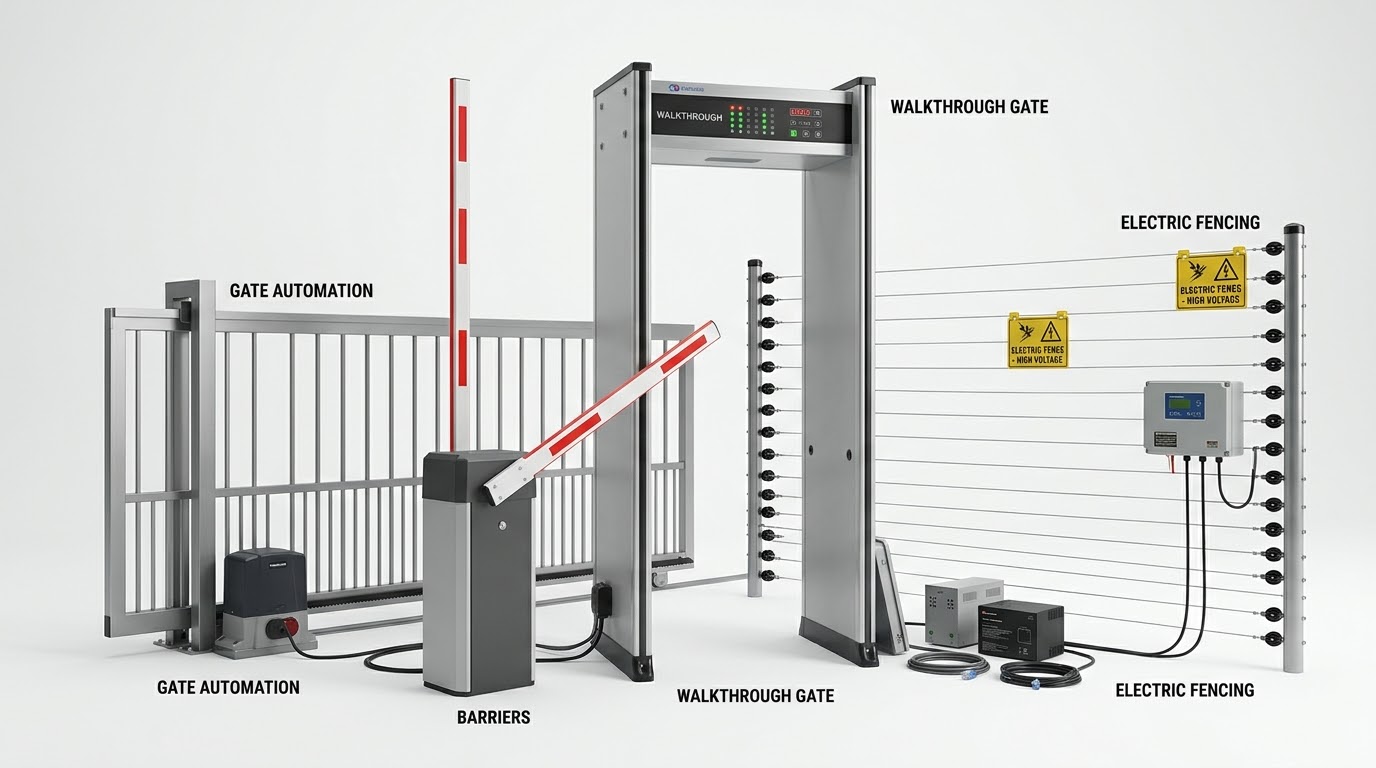
Rack-driven motors for gates that run along the boundary, suited to driveways where there is no room for a gate to swing.
Arm or ram operators for single and double swing gates, selected for the leaf weight, width and the pillar arrangement.
Handsets for regular users, with additional units added and lost handsets removed from the receiver.
Code or card entry for visitors, staff and deliveries where handing out handsets is impractical.
Beams across the opening that stop or reverse the gate when something is in its path. These are a safety requirement, not an accessory.
A key-operated release so the gate can be opened by hand during a power cut or a fault.
We check the gate type, weight, condition, how freely it moves, the pillar arrangement and the power available at the gate.
A written quotation covering the operator, safety devices, control equipment, cabling and any groundwork.
Foundations or mounting prepared, and cabling run to the operator, photocells and control point.
The operator fitted and aligned, with travel limits and force settings adjusted for the gate.
Photocells aligned and tested, obstruction behaviour verified, and manual release demonstrated.
Remote controls and keypad codes issued, and you are shown manual release and basic checks.
null
Manufacturer names shown here belong to those manufacturers. We list them because these are the lines we buy, fit and repair — not to imply any distributorship or formal partnership.
We service and repair existing automatic gates — operators that have become slow or noisy, gates that stop halfway, failed remote receivers, misaligned photocells and damaged manual release mechanisms.
We do not publish prices, because the same job varies widely between sites. A written quotation follows a survey, and these are the factors that move the figure.
We are based at Office 5B, 1st Floor, Royal Plaza, 6th Road, Rawalpindi, Pakistan and carry out security equipment work across Rawalpindi and Islamabad. See areas we serve for more detail, or contact us to arrange a site survey.
A complete installation covers the operator sized for your gate, safety photocells across the opening, a control panel, cabling and power to the gate, remote controls and a manual release for power cuts. Setting the travel limits and force, aligning and testing the photocells, and demonstrating manual release are part of the job — an automatic gate without working safety devices is not finished.
Often yes, provided the gate is structurally sound and moves freely by hand. A gate that binds, drags or has worn hinges and rollers should be repaired first — automation makes an already stiff gate fail sooner, not later.
Every installation includes a manual release, normally key-operated, so the gate can be moved by hand. Where a gate must keep working through outages, a battery backup can be specified.
Yes. An automatic gate moves a heavy object through a space people and vehicles use. Photocells stop or reverse it when the path is blocked, and they are the difference between a gate that is merely convenient and one that is safe around children and vehicles.
Yes. Gate operators are commonly triggered from a video intercom so you can see a caller and let them in without going out — see video intercom installation.
The decision to open a door should not be made blind.
A camera is only worth its price if it is looking at something that matters, in light it can actually handle, recording to a disk with room left on it.
A key tells you nothing.