
Panasonic KX-NS500 / KX-TDE600
Hybrid IP platforms for offices that need a mix of traditional extensions and IP telephony. The NS500 suits small and medium offices; the TDE600 scales to larger sites.
Office 5B, 1st Floor, Royal Plaza, 6th Road, Rawalpindi
Office telephone systems
An office exchange earns its keep in small ways: a call reaching the right desk, one number shared across a department, staff dialling two digits instead of a mobile. We install and programme those systems, extend the exchange you already own rather than replacing it wherever that is possible, and take over the ones nobody can configure since the last engineer left. New and replacement equipment both.
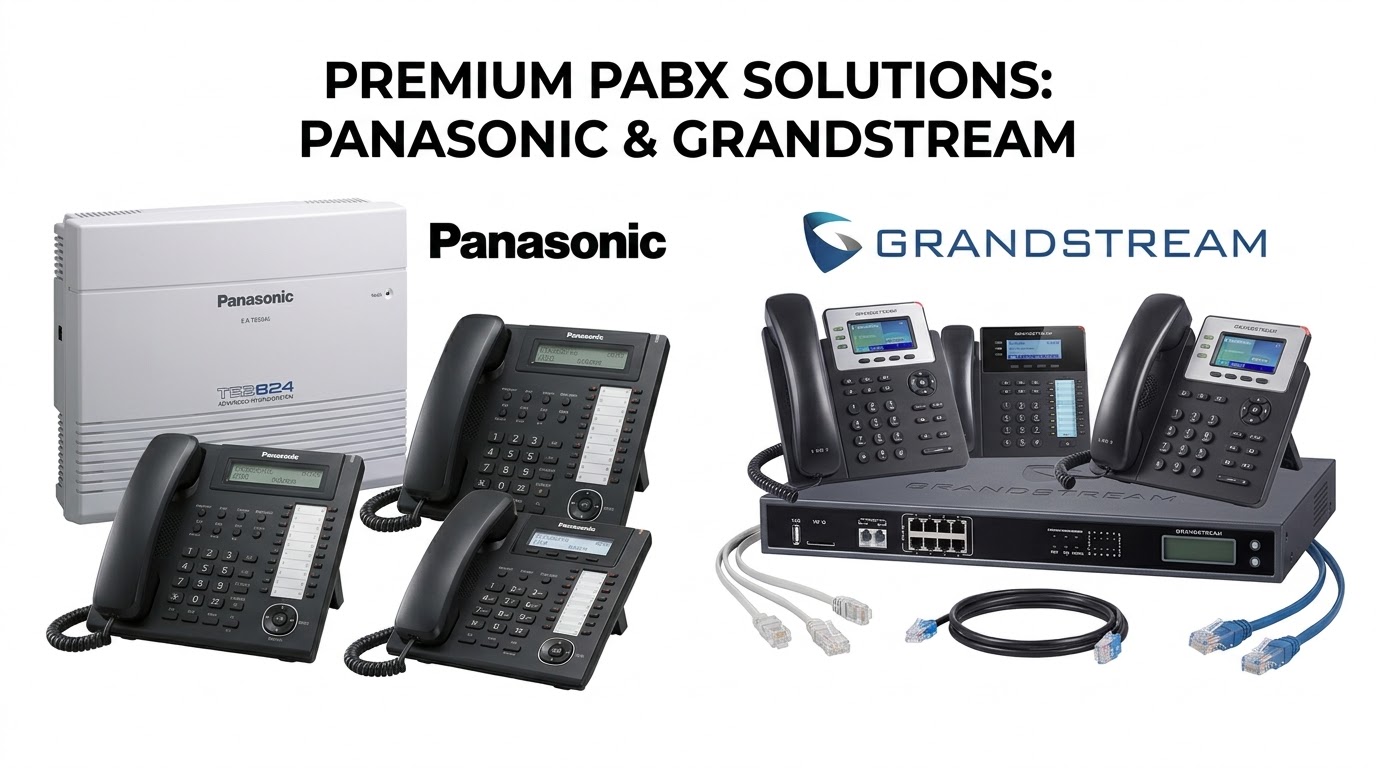
Hybrid IP platforms for offices that need a mix of traditional extensions and IP telephony. The NS500 suits small and medium offices; the TDE600 scales to larger sites.
IP telephone systems and VoIP gateways for offices working over SIP trunks, with IP handsets and remote extensions.
A well-established analogue hybrid exchange for small and medium offices, widely used and straightforward to extend and service.
Telephone sets for the exchange, including programmable-key handsets for reception and simple analog sets for general desks.
Additional extension ports, expansion cards where the exchange needs them, and extension cabling run and terminated as the office grows or is reorganised.
Used exchanges and handsets are often the fastest and most economical way to extend or repair an installed system that is still doing its job.
Call routing, extension numbering, ring groups, transfers and voicemail configured around how your office actually answers calls.
How many extensions, how many outside lines, how calls should reach reception, and what needs to happen after hours.
A written quotation covering the exchange, cards, handsets, cabling and programming.
Extension cabling run and terminated, the exchange mounted and powered, and handsets placed at each position.
Extension numbers, call routing, ring groups, transfer behaviour and voicemail set up to match how you work.
Inbound, outbound, internal and transferred calls tested from each position, and staff shown the handset features they will actually use.
Our PABX work covers Panasonic hybrid exchanges — the KX-NS500 and KX-TDE600 IP/hybrid platforms and the KX-TES824 analogue family — alongside Grandstream VoIP systems, all widely deployed locally and well supported for parts and expansion.
Manufacturer names shown here belong to those manufacturers. We list them because these are the lines we buy, fit and repair — not to imply any distributorship or formal partnership.
We repair and reprogram existing exchanges, replace faulty handsets and cards, add extensions and take over systems where the original programming details are no longer available.
We do not publish prices, because the same job varies widely between sites. A written quotation follows a survey, and these are the factors that move the figure.
We are based at Office 5B, 1st Floor, Royal Plaza, 6th Road, Rawalpindi, Pakistan and carry out telephone exchanges work across Rawalpindi and Islamabad. See areas we serve for more detail, or contact us to arrange a site survey.
A PABX is the exchange inside your building that connects internal extensions to each other and to outside lines. VoIP is a way of carrying calls over an IP network rather than traditional telephone lines. They are not alternatives so much as different layers: a hybrid PABX such as the Panasonic NS500 can run traditional extensions and IP telephony together, which is what most offices moving gradually towards IP actually need.
Usually yes. Whether it needs only cabling and programming, or an additional card or expansion unit, depends on the exchange model and how many extension ports are already in use. We check the installed system before quoting.
Yes. We supply PABX systems, handsets and telephone sets. Used equipment is often the quickest way to extend or repair an existing exchange, and it is supplied on the terms stated in the individual quotation.
Yes. Undocumented systems are common. We work out the current configuration from the exchange itself, then reprogram routing, extensions and voicemail to match how the office runs today.
Traditional extensions run on telephone cable back to the exchange, while IP handsets run on network cable and can take power over Ethernet. If the building already has structured cabling, extensions can often be patched rather than newly run — see networking and structured cabling.
Cameras, door controllers, attendance terminals and IP phones all end up on the same cabling, which is why a network installed carelessly turns every later fault into guesswork.
The decision to open a door should not be made blind.
A camera is only worth its price if it is looking at something that matters, in light it can actually handle, recording to a disk with room left on it.